Conversational Product Search: How It Works With Search, Filters, and Recommendations

Written by Alok Patel
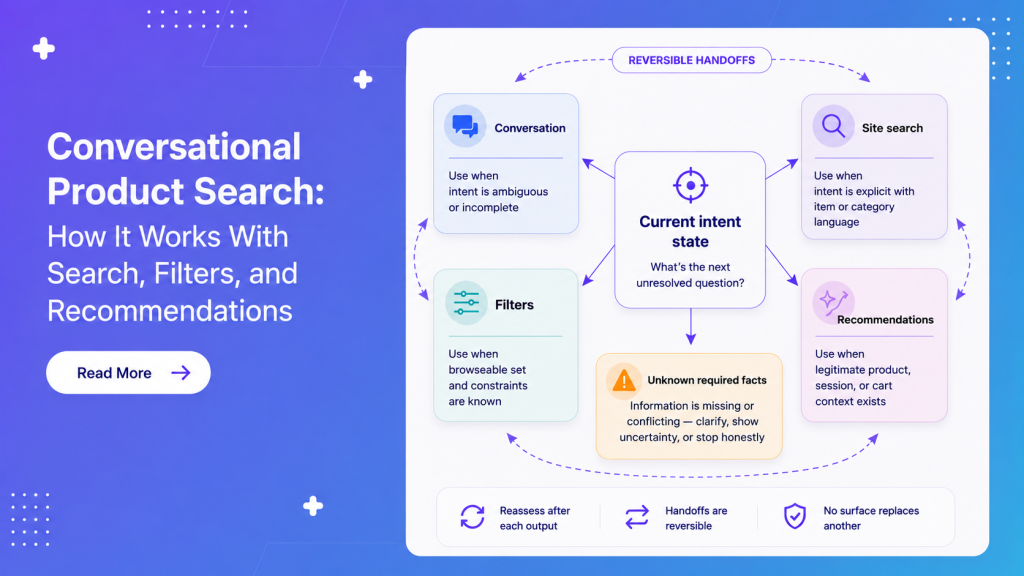
Conversational product search is most useful as a guided intent-disambiguation surface: it can expose ambiguity, ask a discriminating question, and turn a broad goal into a clearer query or visible constraint. Conventional site search is the direct route when the shopper already uses explicit known-item or category language. Filters constrain an existing browseable result set through structured attributes. Recommendations propose labelled next options from legitimate context. These surfaces can pass state to one another; none replaces the others, and no surface alone should be treated as proof of product fit, current availability, compatibility, a sellable variant, or universal shopper preference.
Readers who need the broader definition and trend context can first review what conversational shopping means for ecommerce brands.
The four-surface model, decision inputs, matrix, decision tree, handoff rules, five-state contract, and test cases in this article are original editorial analysis and practical recommendations. They are not a standard taxonomy, measured funnel, universal interface architecture, validated schema, or description of a Wizzy product. The linked external sources support only the narrower mechanics and observations attributed to them.
Four discovery surfaces do four different jobs
The useful question is not which interface should win. It is which surface can address the shopper’s current unresolved question without overstating what its output proves.
The mechanics are distinct in documented systems. Shopify describes storefront search as query-driven and documents filters separately on collection and search-result pages (storefront search; storefront filtering). Shopify also distinguishes related and complementary recommendation intents (product recommendations). These are platform examples, not a universal architecture. The complete comparison below is this article’s original framework.
Original editorial matrix: four connected discovery surfaces
| Surface | Best-fit intent state | Required or legitimate input | Useful output | Output does not establish | Safe next handoff |
|---|---|---|---|---|---|
| Conversation | The goal is broad, ambiguous, incomplete, or changing through follow-up answers. | Shopper language, confirmed prior turns, legitimate current context, and available catalog vocabulary. | A discriminating question, clarified goal, transparent query, or proposed constraint. | That the interpretation is correct, or that any option fits, is available, or is compatible. | Submit a reviewable query, expose confirmed constraints as filters, offer labelled options, ask again, or stop when evidence is insufficient. |
| Conventional site search | The shopper states an item, model, brand and product type, category, or other sufficiently explicit language. | A query string, configured search scope, and the catalog representation available to the search system. | A candidate or result set ordered by the implementation’s search logic. | That the first result is intended or that a returned item satisfies hidden requirements. | Open the set to filters, return to clarification if ambiguity remains, or use a result as context for labelled next options. |
| Filters | A browseable result set exists and remaining constraints map to supported structured attributes. | The current set, available product or variant attributes, and confirmed selected values. | A narrower set with visible, removable constraints. | That missing attributes are satisfied or that availability and compatibility are current. | Return to search when the product type is wrong, clarify missing attributes, or offer alternatives only as labelled recommendations. |
| Recommendations | Legitimate product, cart, session, collection, merchandising, interaction, or user context supports proposing next options. | Only context and relationships the implementation can legitimately use and identify. | Related, similar, substitutable, complementary, popular, or personalised candidates, where that intent is supportable. | That a candidate is a verified match, compatible item, available variant, or universal preference. | Let the shopper search, filter, compare, clarify, reject, or stop from the proposed option. |
No surface ranks above another in this framework. A useful clarification is not proven intent. A returned result is not proven fit. A selected filter is not proof that all requirements are represented in the catalog. A recommendation is not verified suitability. Treating those distinctions as an operating guardrail keeps the response no broader than its evidence.
“Conversational” also does not name one universal capability. Google’s product-specific conversational-filtering documentation describes a bounded flow that starts from broad search results, asks attribute questions, and applies answers as filters; it explicitly distinguishes that flow from answering shopper questions (Google Cloud conversational filtering). The example shows one possible conversation-to-filter handoff. It does not establish a universal question order, architecture, data practice, or outcome.
Start with the shopper’s current intent state, not a preferred interface
Before selecting a surface, inspect five inputs:
- Intent clarity: Is the request a broad goal, an under-specified need, explicit item or category language, a structured constraint set, or an invitation for options?
- Result-set state: Does a browseable candidate set already exist, or is the product type still unresolved?
- Legitimate context: Which query, category, applied filter, viewed item, cart item, explicit answer, or prior interaction is actually available and appropriate to use?
- Constraint status: Which requirements are hard constraints, which are preferences, and which are inferred rather than confirmed?
- Unknowns and conflicts: Which required attributes, relationships, availability facts, compatibility facts, or shopper answers are missing, stale, or contradictory?
General conversational-search research treats ambiguous or under-specified requests and clarification questions as a mixed-initiative information-seeking problem (ACL Anthology research record). A peer-reviewed survey likewise treats ambiguous-query clarification and evaluation as unresolved conversational-search challenges (ACM Computing Surveys). That research is not ecommerce outcome evidence and does not show that every assistant interprets intent reliably.
The following ordered tree is an adaptable editorial heuristic, not a fixed implementation sequence:
- Check required facts first. If a hard constraint or required fact is missing, stale, unsupported, or conflicting, ask for clarification when one answer could change the route. Otherwise expose uncertainty, defer to an authoritative source or human process where one exists, or stop honestly.
- Use conversation for unresolved ambiguity. If the goal remains broad or incomplete, ask one discriminating question and update only confirmed state.
- Prefer a question whose answer changes the product type, query, or visible constraint.
- Preserve the shopper’s original wording separately from the interpretation.
- Use search for explicit language. If the shopper states a sufficiently explicit item, model, product type, or category, submit a transparent conventional search query.
- Use filters for structured refinement. If a browseable result set exists and confirmed remaining constraints map to supported attributes, expose them as visible, removable filters.
- Use recommendations for contextual proposals. If legitimate context supports next options, offer them with a supportable recommendation intent or reason rather than as verified matches.
- Reassess after every output. Hand off or loop only when the next unresolved question belongs to another surface. If it cannot be resolved safely, retain the unknown and stop.
No reviewed evidence supports a numeric ambiguity threshold, a fixed number of turns, or one preferred surface hierarchy. A discriminating question earns its place by changing the decision state, not merely by adding dialogue.
Hand conversation to search and filters without hiding the interpretation
When conversation produces explicit item or category language, the next useful output is a reviewable search query—not an opaque assertion that intent has been solved. Keep the original request available and show the interpreted query or product type. If the result set exposes unresolved ambiguity, return to a discriminating question instead of treating the first result as intended.
Once a browseable result set exists, move only confirmed, supported structured constraints into visible filters. Shopify’s documentation provides one platform example in which search and collection pages expose filters based on product or variant data, with applied values represented separately (Shopify storefront filtering). Baymard’s public research likewise distinguishes query types and discusses visible search-to-filter refinement for structured features (ecommerce search query types; filter UI). These sources do not prove universal data completeness or interface behavior.
An applied filter should remain inspectable and removable. A requirement that the catalog cannot represent stays unknown; it does not become satisfied by omission. If constraints conflict, let the shopper revise them rather than silently relaxing a hard requirement.
The cases below are generic planning categories, not real shopper transcripts, query logs, products, result sets, or test outcomes.
Original editorial handoff cases for conversation, search, and filters
| Starting state | Confirmed information | Unresolved information | Current surface | Handoff action | State preserved | Prohibited implication |
|---|---|---|---|---|---|---|
| Broad goal | A general goal has been stated. | Product type or discriminating requirement. | Conversation | Ask one question; when the answer makes the product type explicit, submit a visible query. | Original wording, confirmed answer, and remaining unknowns. | That the conversation proved full intent or product fit. |
| Broad goal with supported structured requirements | Product type and selected constraints are confirmed. | Any requirement not represented in current data. | Conversation | Open a browseable set and expose supported confirmed constraints as removable filters. | Query interpretation, confirmed constraints, unsupported requirements, and provenance. | That every requirement became a filter or is satisfied. |
| Explicit item or category language | A transparent query can be formed. | Structured refinements that remain relevant. | Search | Return a candidate set, then let filters narrow supported attributes. | Original request, submitted query, applied filters, and unknowns. | That the first result is intended or meets hidden constraints. |
| Non-empty set with the wrong product type | The returned set does not match the confirmed interpretation. | The correct product type or query language. | Search or filters | Return to search or a discriminating clarification. | Original request, rejected interpretation, and still-confirmed constraints. | That a non-empty result set is a successful match. |
| Conflicting hard constraints | The conflict is visible. | Which requirement, if any, the shopper chooses to revise. | Any surface | Clarify, expose the conflict, or stop; do not relax a requirement automatically. | Both constraints, their sources, and shopper control. | That an unconfirmed trade-off was accepted. |
An honest no-safe-candidate state can be correct. It should remain a visible outcome without recreating a separate zero-result diagnostic or inventing a match merely to continue the flow.
Hand recommendations back to search, filters, or clarification as labelled options
Recommendations begin from context, not from proof that every current requirement is satisfied. The context might be a product, cart, session, collection, merchandising relationship, interaction history, or user information where its use is legitimate and supportable. No implementation should be assumed to use all of these inputs.
Shopify distinguishes related and complementary recommendation intents and documents different inputs or configuration paths for them (recommendation guidance; Storefront API product recommendations). Amazon Personalize documents a separate product-specific example in which some recommendations can update from recorded interactions (AWS documentation). These examples show that recommendations can be conditioned by different contexts. They do not prove relevance, consent, explanation quality, compatibility, availability, preference, or business impact.
In this framework, a recommendation remains a proposal. Give its next unresolved job to the appropriate surface:
- Recommendation to search: investigate an offered item or category through explicit query language.
- Recommendation to filters: constrain a candidate set when supported structured requirements remain.
- Recommendation to comparison: compare several labelled options only when the necessary comparable facts are available.
- Recommendation to conversation: clarify why the option is relevant or resolve an unstated or conflicting hard requirement.
- Recommendation to unknown or stop: do not advance a compatibility, availability, or other required fact that lacks current authoritative evidence.
A related option is not automatically suitable. A complementary label is not compatibility evidence. A personalised proposal is not a universal preference. A click, prior interaction, cart presence, returned product, or purchase should not be stretched into proof that every current constraint is satisfied.
| Context category | Supportable label | Unresolved fact | Next surface or action | Shopper control | Must not imply |
|---|---|---|---|---|---|
| Product context | Related option, where that relationship is supportable. | Whether the option meets the shopper’s current requirements. | Search, filter, compare, or clarify. | Inspect the basis, reject the option, or change constraints. | Verified substitute, compatibility, or availability. |
| Cart or product context | Complementary option, where that intent is supportable. | Compatibility, need, and current availability. | Verify from an authoritative source, clarify, or stop. | Accept, reject, or inspect the relationship. | That “complementary” means necessary or compatible. |
| Interaction-informed context | Contextual proposal, without overstating preference. | Current intent and hard constraints. | Conversation, search, filters, or rejection. | Revise the request and avoid carrying unsupported assumptions. | That prior behavior proves current preference. |
| Proposed substitute | Possible alternative only. | Fit, compatibility, sellable variant, or another hard requirement. | Verify, compare, clarify, or stop. | Keep the original option and alternative distinct. | Verified match or satisfied hard constraint. |
Preserve five states whenever one surface hands control to another
A handoff should transfer evidence and uncertainty, not just a destination. The five-state contract below is original practical guidance. It is not a validated schema, data-protection policy, mandatory interface, legal standard, universal safety guarantee, or Wizzy architecture.
- Original request– Retain the shopper’s language for review rather than silently replacing it with a system interpretation.
- Confirmed interpretation– Record only the product type, goal, or query interpretation supported by explicit answers or legitimate current context.
- Confirmed constraints– Carry only shopper-stated or otherwise grounded requirements. Keep hard constraints separate from inferred preferences, and do not silently soften, drop, invent, or mark a requirement satisfied.
- Unknown or conflicting constraints– Keep missing, stale, unsupported, or contradictory required facts visible. Route them to clarification, visible uncertainty, deferral, an authoritative source or human process where one exists, or an honest stop.
- Provenance and shopper control– Preserve the supportable source or reason for the state. Let the shopper inspect or reverse applied constraints, and keep query relevance or recommendation context distinct from product-fit status.
At each handoff, ask:
- What changed?
- What evidence authorised that change?
- What remained unresolved?
- Can the shopper inspect, remove, or reverse the interpretation or constraint?
- Which surface is suited to the next unresolved question?
Visible provenance does not itself prove correctness. It makes the basis and limits of a decision available for review, while preserving the distinction between a proposed option and a verified product fact.
Use unknown and constraint cases to test the framework before expanding claims
A useful review asks whether the experience makes the narrowest supportable claim and chooses a safe handoff or stop. It does not need a fabricated success story or numeric score.
The following matrix is an original, non-exhaustive planning set. The cases are hypothetical categories only: they contain no observed shopper behavior, real query, transcript, catalog row, result, recommendation event, experiment, metric, threshold, or product test outcome. The matrix does not validate a model, certify a release, establish a benchmark, or prescribe a launch decision.
| Case | Starting state | Required evidence | Selected surface | Expected handoff or stop | State to preserve | Prohibited implication | Reviewer note |
|---|---|---|---|---|---|---|---|
| Broad goal with several plausible product types | Intent is ambiguous. | A shopper answer that can discriminate among routes. | Conversation | Ask one discriminating question, then reassess. | Original wording, answer, and remaining ambiguity. | That inferred intent is confirmed. | Does the answer materially change the route? |
| Follow-up resolves one constraint but leaves another unknown | Interpretation is partly confirmed. | Support for the unresolved required fact. | Conversation or visible unknown | Clarify again only if useful; otherwise defer or stop. | Both confirmed and unknown constraints. | That one answer resolves all intent. | Can the unresolved fact remain visible? |
| Explicit known-item or category language | A transparent query is available. | Configured search scope and current catalog representation. | Search | Return a candidate set; filter or clarify next. | Original request and submitted query. | That the first result is the intended item. | Can the shopper inspect the query interpretation? |
| Browseable set with a supported hard constraint | A candidate set and structured attribute exist. | Confirmed value and current filterable data. | Filters | Apply a visible, removable constraint. | Constraint value and provenance. | That every needed constraint is represented. | Can the shopper reverse the filter? |
| Requested constraint absent from catalog data | A required fact cannot be represented. | An authoritative source or shopper clarification, if available. | Visible unknown | Clarify, defer, or stop. | The unsupported requirement and its status. | That omission means satisfaction. | Is the data gap explicit? |
| Applied constraints eliminate the set | No candidate remains under current constraints. | Shopper choice before any requirement changes. | Conversation or filters | Show the state and let the shopper revise; otherwise stop. | All hard constraints and any chosen revision. | That a requirement was silently relaxed. | Who controls the trade-off? |
| Related or complementary proposal | Context supports a labelled option. | Supportable recommendation intent and any required product facts. | Recommendations | Search, filter, compare, clarify, reject, or stop. | Context label, constraints, and unknowns. | Fit, need, compatibility, or availability. | Is proposal status distinct from product fact? |
| Interaction-informed proposal with changed current intent | Past context and current request diverge. | The shopper’s current confirmed state. | Conversation or search | Prioritise current confirmed intent; discard unsupported assumptions. | Current request and the provenance of prior context. | That earlier behavior proves present preference. | Can stale context be rejected? |
| Unknown compatibility or current availability | A candidate exists but a required fact is unverified. | A current authoritative relationship, variant, inventory, or commerce source. | Unknown or authoritative handoff | Verify, defer, or stop honestly. | Candidate status and the unresolved hard fact. | That result presence or recommendation proves the fact. | Is the source current and at the right granularity? |
| Conflicting hard constraints or no safe candidate | No supportable option satisfies the confirmed state. | Shopper-directed revision or new authoritative evidence. | Conversation, visible uncertainty, or stop | Expose the conflict; do not invent or broaden a result. | Original request, all constraints, conflict, and control. | That an unapproved trade-off was accepted. | Does the experience stop without false certainty? |
Reviewers can expand this set with representative categories from their own operations, but every added case needs real evidence if it is reported as an observed result. No reviewed source supplies article-specific logs, catalog data, availability feeds, compatibility relationships, user studies, or experiments.
Select the surface for the next unresolved question
Use conversation to clarify ambiguity, conventional search to resolve explicit language into candidates, filters to constrain a browseable set through supported visible attributes, and recommendations to propose labelled next options from legitimate context. Then reassess. A changed state may make a different surface useful; that is a handoff, not evidence that one surface has replaced the others.
Preserve the original request, confirmed interpretation, confirmed constraints, unknown or conflicting constraints, and provenance with shopper control. Give the next unresolved question to the surface suited to it. When a required fact cannot be established safely, keep the uncertainty visible and stop rather than inventing certainty.
This complete framework remains original editorial analysis. A clarified request, result, filter, or recommendation can be useful without proving fit, current availability, compatibility, a sellable variant, or universal preference. Teams can review representative handoff and unknown-state cases with the ecommerce, product, CX, search, merchandising, catalog, inventory, and other stakeholders relevant to their organisation without treating the review as a product certification, outcome claim, or release decision.
Share this article
Help others discover this content